Dead, Declining or Severely Damaged Trees
Removal may be considered when the tree is no longer being retained and its condition or damage makes removal the requested scope.
Residential tree removal · Mesa & East Valley
Bynum Tree and Landscape
Residential tree removal for dead, storm-damaged, downed, unwanted, or poorly placed trees, with stump grinding available when access and site conditions allow.
Each quote accounts for nearby structures, equipment access, debris handling, the stump option, and how the approved work area is expected to be left.
Free on-site estimates within the service area.
Not every tree problem requires removal. The right service depends on the tree, the homeowner's goal, surrounding property, and what can reasonably be addressed with pruning.
Removal may be considered when the tree is no longer being retained and its condition or damage makes removal the requested scope.
A tree may be healthy enough to stand but still conflict with the homeowner's plans, available space, structures, or future landscaping.
Broken, split, uprooted, or heavily damaged trees may require removal when the site and surrounding hazards allow the work to be completed safely.
If the tree is being kept and the concern is branch clearance, selected overextended growth, or deadwood, pruning may be the better service.
Removal work is planned around the tree and the property—not just the trunk diameter.
The tree, stump option, nearby structures, access points, and cleanup expectations are reviewed before the quote is approved.
Gate width, driveway space, walls, pools, roofs, landscaping, and the debris route affect how the removal is approached.
Quoted tree work includes tree-debris haul-off and cleanup. Stump grinding is included only when it is part of the approved scope.
No power-line tree work.
Bynum Tree and Landscape does not perform tree work on or near electrical lines. Stay clear and contact the serving utility when a tree is touching or close to power lines. SRP tree and power-line guidance ↗
Two completed projects show how the site and planting location can change the removal scope.
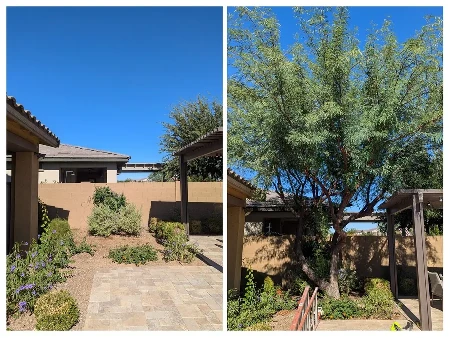
Eastmark · Mesa, AZ · Mesquite
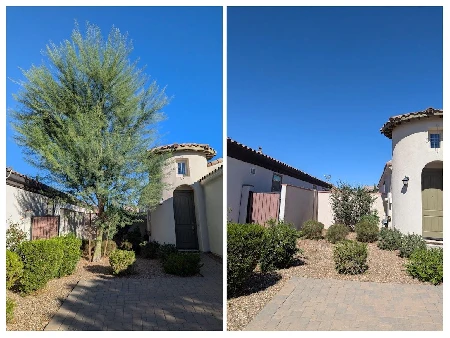
Eastmark · Mesa, AZ · Palo Verde
Stump grinding is optional. Include it in the removal quote when the stump also needs to be addressed.
Adding stump grinding to the same project is usually the most efficient option. Mention plans for gravel, turf, replanting, or other landscaping during the estimate so the intended finished area can be discussed.
Starts at $300
Availability depends on equipment access, stump size, roots, surrounding materials, and site conditions.
Removal pricing depends on the actual work required at the property. A photo can help with an initial ballpark, but the on-site estimate confirms the final scope and price.
Height, trunk size, lean, dead or damaged sections, and total debris volume affect the removal plan.
Roofs, walls, pools, fences, driveways, landscaping, and neighboring property can change how controlled the work must be.
Gate width, slopes, equipment access, driveway space, and the distance debris must move affect setup and production time.
Minimum service visit: $300. Final pricing is confirmed during the on-site estimate after the removal scope, access, and stump option are reviewed.
If a customer is not satisfied with a completed service, Bynum Tree and Landscape will first make a reasonable effort to correct the agreed scope. If the issue cannot be corrected, the charge for that specific service is waived or refunded if already paid.
Applies to the approved service scope. Additional work, changed scope, future tree growth or health, storm damage, and conditions outside the approved work are not included.
“Provided great communication, skilled work, on time, and complete thorough clean up.”
— James T. · Google review excerpt
“Prompt & courteous service/dead tree removed/hauled away/stump grind/thorough cleanup…”
— Steve H. · Google review excerpt
If the tree is being kept and the concern is branch clearance, deadwood, or selected overextended growth, tree trimming and pruning may be the better service.
Yes, when the tree condition, site access, and surrounding hazards allow the work to be completed safely. Stay clear of unstable trees and hanging branches.
No. Stump grinding is optional unless it is specifically included in the approved removal scope.
No power-line tree work. Stay clear and contact the serving utility for trees touching or near electrical lines.
Text 2–6 photos, your ZIP code, and nearest major crossroads. Include the full tree, trunk base, nearby structures, and gate or driveway access. Mention whether stump grinding is wanted. Photos can help with an initial ballpark; the free on-site estimate confirms the final scope and price.
Serving Mesa, Apache Junction, Gold Canyon, Gilbert, Queen Creek, and nearby East Valley communities. Check service areas →